

.
WHAT IS COMPASSION-FOCUSED THERAPY?
Compassion-Focused Therapy (CFT), a biopsychosocial model, helps people develop compassion toward themselves and others to prevent and alleviate suffering. Based on the science of compassion, clients learn to develop a range of mind/body practices through Compassionate Mind Training (CMT), building a “well” of inner resources to face and overcome difficult emotions and life events. CFT is particularly beneficial for people struggling with self-criticism, low self-esteem, shame, or trauma, and has been shown to have a positive impact across a broad range of mental health issues. Grounded in neuroscience and evolutionary science, CFT continues to be extensively researched.
See below for full details about the brain science behind CFT, descriptions of how CFT works, and resources—articles, videos, and podcasts—to explore further.
Compassion isn’t about getting rid of difficult emotions. It’s about changing the relationship we have with them.
I work primarily with thoughtful, capable, hard-working, often overwhelmed women struggling with harsh self-criticism, shame, or a persistent sense of not being good enough. Compassion-Focused Therapy (CFT), the heart of my approach, uses science-based practices to alleviate suffering related to anxiety, depression, burnout, loss, trauma, relationship issues, and life transitions. CFT helps people develop the compassion needed to explore, manage, and overcome difficult emotions.
The Brain Science Behind Compassion
Contrary to the belief that our brains, once developed, remain static throughout our lives, neuroplasticity is our brain’s capacity to reorganize and create new structures and connections in response to experiences, learning, sensory stimulation, and injury.
Compassionate Mind Training (CMT), an element of CFT, offers practices including meditation, mind/body exercises, imagery, soothing breathing, and developing a compassionate inner voice. These practices can influence the way our brains and nervous systems respond to stress and emotional challenges. Compassion training can impact areas of the brain associated with reward and positive emotions, as well as structures involved in emotion regulation, including the prefrontal cortex. It can also influence physiological responses associated with stress and the hormones and neurotransmitters involved in bonding, motivation, and positive emotion.
When experienced, compassion can activate the parasympathetic nervous system and vagus nerve—our “rest and digest” system—helping to slow our heart rate, increase heart rate variability, and counteract the effects of stress. In other words, compassion can help put the brakes on emotional responses driven by threat and negative patterns, supporting a calmer, more resilient state.
How Does CFT Work?
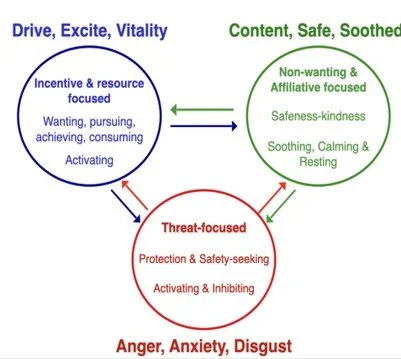
Compassion-Focused Therapy is rooted in the theory that there are at least three types of emotion-regulation systems—parts of our brain that work together to control and maintain our emotions:
The Threat-Focused System — our protective, safety-seeking system
The Drive System — our incentive- and resource-focused system
The Soothing System — our safeness, kindness, calming, and resting system
These emotional systems help us achieve important goals in life. Our threat system protects us when we sense danger, our drive system motivates us to seek resources and achieve, and our soothing system creates a “rest and digest” response, supporting feelings of safety, contentment, and calm.
But when these systems are out of balance—when anger or anxiety overwhelm us, when our desire to achieve goes into “overdrive,” or when feelings of safety and contentment elude us—we can struggle.
My goal as your therapist is to teach you how to understand, access, and expand your capacity for compassion by helping you identify these emotional systems and learn to integrate the compassionate practices of CMT (Compassionate Mind Training). When used consistently, these practices can help you re-regulate and rebalance your emotions, reduce emotional distress, and begin to develop fuller, more resilient, and engaged lives.
Clients regularly share that they experience increased calm, reduced stress, clearer thinking, and greater self-compassion as they develop the courage and wisdom to face difficult emotions and life events.
Consider exploring some of the compassion-focused resources below:
COMPASSION-FOCUSED THERAPY RESOURCES
My Three Circles — An app to help balance the three emotional systems, including meditations, mind/body exercises, and practices for building compassion.
The Compassionate Mind (Compassion-Focused Therapy) by Paul Gilbert, Ph.D.
The Compassionate Mind Foundation — Initiated by Paul Gilbert, Ph.D., the creator of Compassion-Focused Therapy.
Dr. Stan Steindl — Videos and podcasts focused on the science and practice of compassion.
My presentation: Building Compassion to Cope with Grief and Loss — Presented with It’s Lifey, an organization committed to supporting widows struggling with grief and loss.
Lenore Mewton, LICSW Facebook Page
The Neurological Benefits of Reading
Warmth, Kindness and Compassion: Antidotes for Self-Criticism and Shame